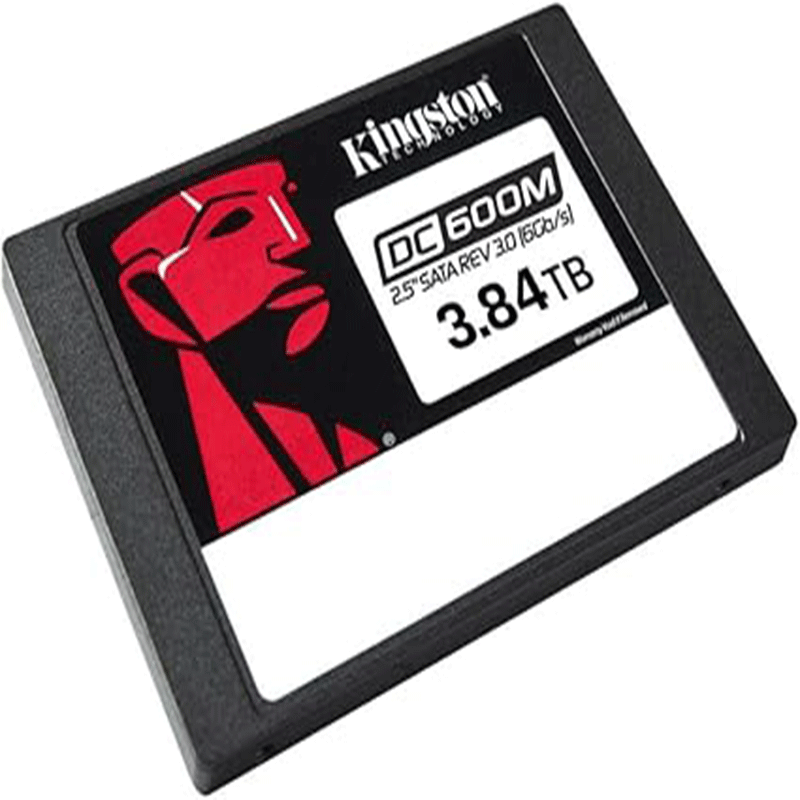
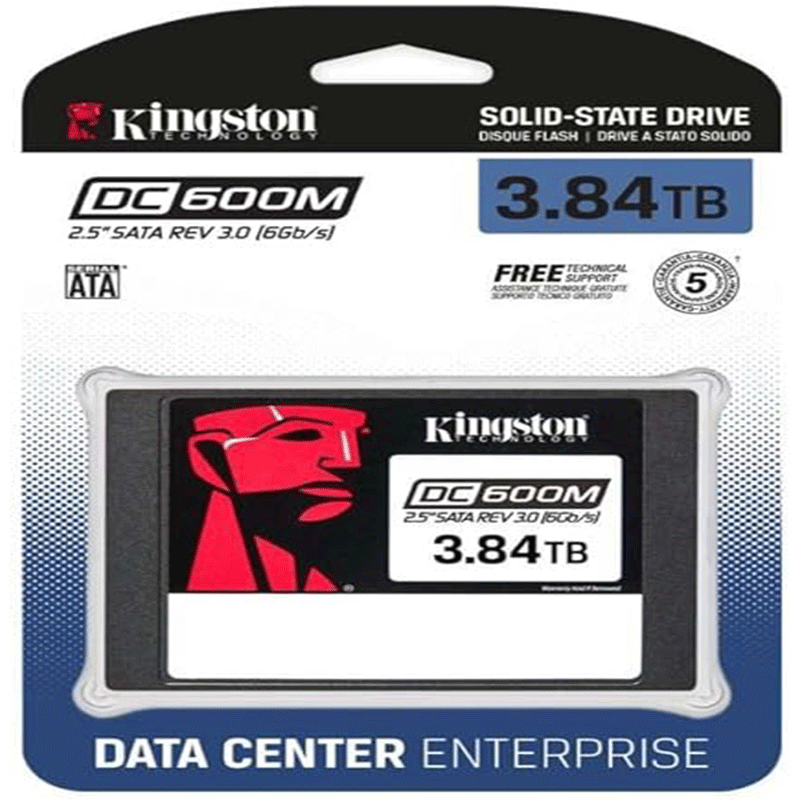
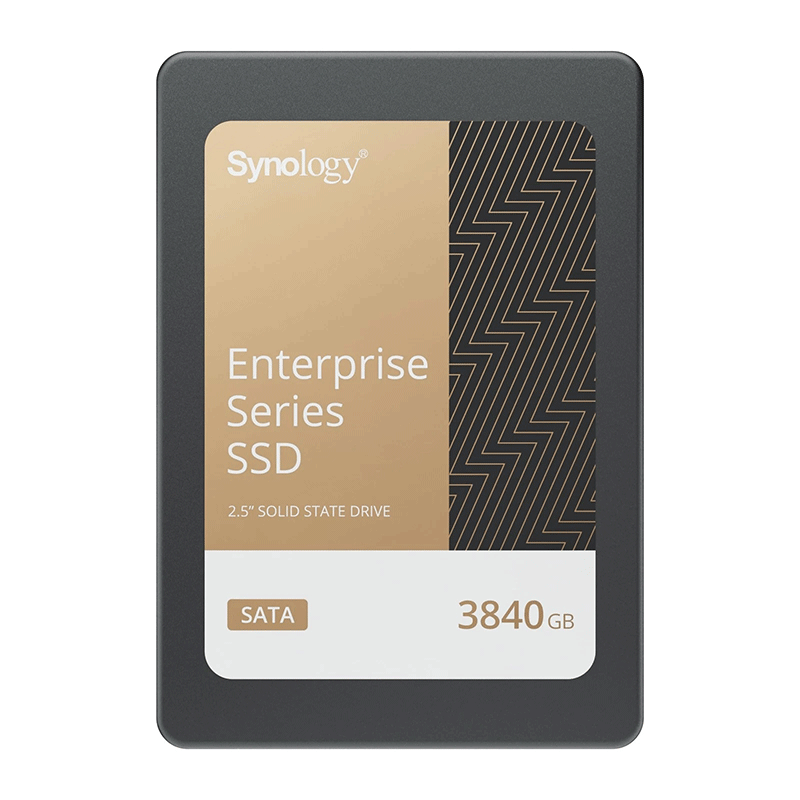
Kingston Enterprise 3840G DC600M (Mixed-Use) | 2.5″ SATA SSD | SEDC600M/3840G
Description Overview
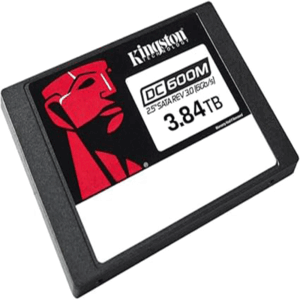
Kingston DC600M 3.84 TB (SEDC600M/3840G) is a 2.5-inch enterprise-class SATA SSD tailored for data-center and server-class storage. It uses 3D TLC NAND with onboard DRAM cache, and connects via SATA Rev. 3.0 (6 Gb/s). It delivers up to 560 MB/s read and 530 MB/s write, plus strong random I/O performance — roughly 94,000 IOPS read / 59,000 IOPS write (4 KB) under steady-state. Built for “mixed-use” workloads (balanced read/write), it offers consistent latency & IOPS, hardware-based power-loss protection (PLP), and enterprise-level reliability — making it ideal for servers, virtualization hosts, databases, RAID arrays, and other business-critical storage systems. With 3.84 TB capacity and high endurance / long lifetime (enterprise-grade TBW / MTBF), it gives a reliable large-capacity storage solution for demanding workloads.
Key Specifications
- Capacity: 3.84 TB
- Form Factor: 2.5 inch
- Interface: SATA Rev. 3.0 (6 Gb/s), backwards compatible with SATA Rev. 2.0 (3 Gb/s)
- NAND Type: 3D TLC
- DRAM Cache: Yes (on-board DRAM)
- Sequential Read Speed: Up to 560 MB/s
- Sequential Write Speed: Up to 530 MB/s
- Random 4 KB Read IOPS: Up to 94,000
- Random 4 KB Write IOPS: Up to 59,000
- Quality of Service (QoS) Latency (99.999%): ~200 µs read / ~300 µs write
- Endurance (TBW): 7,008 TBW (equivalent to ~1 DWPD for 5 years, or ~1.66 DWPD for 3 years)
- Power-loss Protection (PLP): Yes (hardware-based capacitors)
- Power Consumption: Idle: ~1.30 W; Average: ~1.45 W; Max Read: ~1.6 W; Max Write: ~3.6 W
- Operating Temperature: 0 °C to 70 °C
- Storage Temperature: –40 °C to 85 °C
- Dimensions: 69.9 mm × 100 mm × 7 mm
- Weight: ~92.34 g
- Mean Time Between Failures (MTBF): 2,000,000 hours
SEDC600M/3840G Features
- It’s a 2.5-inch SATA 3.0 (6 Gb/s) enterprise SATA SSD — so it works in any standard SATA slot or bay.
- Uses 3D TLC NAND with onboard DRAM cache, which helps deliver stable performance.
- Performance specs: sequential read up to ~560 MB/s, sequential write up to ~530 MB/s.
- Good random I/O performance: ~94,000 IOPS (4K read) / ~59,000 IOPS (4K write) under steady state.
- Latency / QoS consistency: 99.999% quality-of-service (QoS) — reads around 200 µs, writes around 300 µs under load (for the 3.84 TB model).
- Durability / endurance: Rated to very high endurance — e.g. the 3.84 TB drive is rated ~7008 TBW, which corresponds to roughly 1 Drive-Write-Per-Day over 5 years.
- Power-loss protection (PLP): On-board capacitors to help protect data in case of unexpected power loss — important for servers and critical workloads.
- Enterprise-oriented design: Intended for “mixed-use” workloads — meaning a balance between reads and writes, suitable for data-center, server, virtualization, web hosting, database, or RAID applications.
What It’s Good For
- Server / data-center workloads (virtualization hosts, web servers, database servers, etc.), where you need consistent performance, low latency, and reliability under mixed read/write loads.
- Enterprise RAID arrays or SAN/NAS setups — because of high endurance, power-loss protection, and consistent IOPS/latency.
- Workload-intensive applications: Databases, analytics, virtualization, caching layers — anywhere that benefits from both good sequential throughput and sustained random I/O.
- Long-term reliability: If you want storage that holds up over many years under heavy or moderate loads, the TBW and PLP features make it a solid choice.
Things to Know / Potential Limitations
- It’s a SATA drive — so although it’s very good for SATA-based server/storage infrastructure, it’s not as fast as modern NVMe — so if you need maximum throughput or lowest latency (especially for very heavy random I/O), NVMe drives will still outperform it.
- The “mixed-use” classification means it’s not optimized for pure heavy write workloads (compared to some “write-intensive” enterprise SSDs). For very write-heavy workloads, there are SSDs with higher endurance (DWPD/TBW) optimized for writes.
- If you’re using it for purely consumer tasks (gaming, desktop OS, occasional storage), you likely won’t harness its full enterprise-level potential (and might pay more than typical consumer SSDs).
- As with any enterprise device: to get full benefit, you need proper system configuration (good SATA controllers, stable power supply, constant cooling, possibly RAID controller if using multiple drives).
For Whom This Is a Good Fit
- Data-center operators, server admins, small-to-mid sized business owners hosting virtual machines, databases, or web services.
- Professionals needing reliable, high-capacity SSD storage for enterprise workloads rather than just consumer desktops or laptops.
- Anyone building a RAID array or storage server using SATA infrastructure and wanting SSD-level performance + enterprise-grade reliability.


Reviews
There are no reviews yet.