Kingston ValueRAM 32GB 2666MT/s DDR4 Non-ECC CL19 SODIMM 2Rx8 1.2V KVR26S19D8/32 Laptop Memory
Description Overview
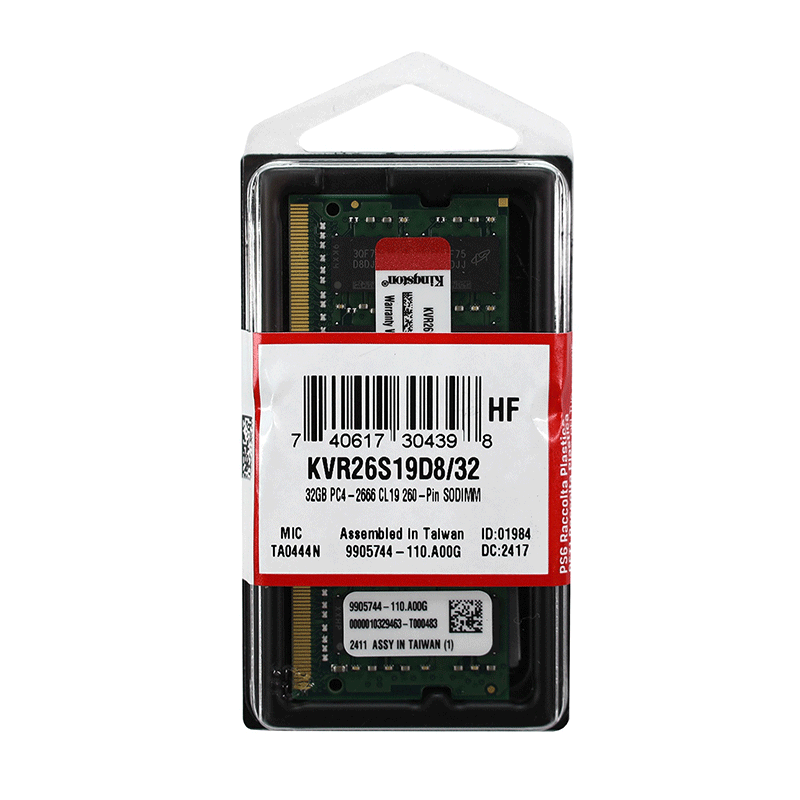
Kingston ValueRAM KVR26S19D8/32 is a 32GB DDR4-2666MHz laptop memory module designed for reliable, standard-performance upgrades. It is a 260-pin SO-DIMM, runs at 2666MT/s, operates at 1.2V, and uses CL19 latency. The module is Non-ECC, unbuffered, and built with a dual-rank (2Rx8) configuration for broad compatibility with most DDR4-based laptops. It offers a stable, plug-and-play memory expansion ideal for boosting multitasking, productivity, and overall system responsiveness.
Key Specifications
- 32 GB DDR4 memory, SO-DIMM format (260-pin) — meant for laptops / small form-factor machines.
- Speed: 2666 MT/s (PC4-21300)
- Latency: CL19 (19-19-19)
- Voltage: 1.2 V — the standard for DDR4 laptop RAM.
- Non-ECC (i.e. no error-correcting code) and unbuffered — normal for consumer laptops.
- Dual-rank configuration (2Rx8) — memory chips on both sides of the module.
Key Features & Design Details
- Power & voltage specs: operates at 1.2 V (VDD, VDDQ). Also uses VPP = 2.5 V, and SPD supply (VDDSPD) in the 2.2 V–3.6 V range.
- On‑die Termination (ODT): supports nominal and dynamic on‑die termination for data, strobe, and mask signals — improves signal integrity and stability at DDR4 speeds.
- Low‑Power Auto Self Refresh (LPASR): reduces power consumption when memory is idle.
- Data Bus Inversion (DBI): supported for data bus — helps reduce data‑signal noise and improve reliability.
- On‑die VREFDQ generation & calibration: internally manages reference voltage for data‑lines (VREFDQ) — this helps maintain stable data signalling without external reference voltage.
- Dual‑Rank (2Rx8) memory organization: module is dual‑rank, which can improve memory access throughput under certain workloads and memory‑controller designs.
- Serial Presence Detect (SPD) EEPROM on‑board: allows the system BIOS/firmware to automatically detect module characteristics (timing, voltage, size), enabling plug-and-play compatibility and correct configuration.
- Internal structure: 16 banks (4 groups of 4 banks each): standard DDR4 bank organization for efficient internal memory access.
- Burst options: Burst‑Chop (BC4) or Burst‑Length (BL8): via the mode register set (MRS) the module supports a fixed burst‑chop of 4, or a burst‑length of 8 — helps with read/write efficiency depending on the workload.
- “Fly‑by” address/ command bus topology: a design architecture for how command/address signals are routed on the module, to reduce signal skew and improve stability at high frequency.
- Terminated control/command/address bus: to ensure the control and address signals are properly terminated (prevent signal reflection), which enhances stability.
- Environmental & compliance specs: RoHS compliant, halogen‑free — meaning reduced hazardous substances; JEDEC‑standard compliance ensures interoperability.
- Form‑factor / physical design: 260‑pin SO‑DIMM, 69.6 mm × 30 mm (approx), 3.7 mm thick — standard laptop‑memory module size.
- Unbuffered, non‑ECC design: as is standard for consumer laptops (vs. server ECC/registered memory).
What it’s good for
-
Upgrading a laptop from 8 GB/16 GB to 32 GB — great for heavy multitasking, memory-intensive apps, VMs, photo/video editing, etc.
-
Smooth performance with 2666 MHz speed — many laptops with DDR4-2666 support will run this module natively.
-
Reliable and widely compatible: this is a mainstream memory module designed to meet JEDEC standards.
What to check before buying/using
-
Make sure your laptop supports DDR4 SODIMM, 260-pin, and 2666 MHz (or is backward/forward compatible). If your laptop uses desktop-DIMM or ECC RAM, this won’t work.
-
If your laptop already has 1 memory stick, mixing brands or mismatched speed/rank may cause instability — better to use identical modules or replace all sticks. (Common RAM-upgrade advice.)
-
Because it’s dual-rank (2Rx8), some older laptops may have limitations — though most modern DDR4 laptops handle it fine.


Reviews
There are no reviews yet.