

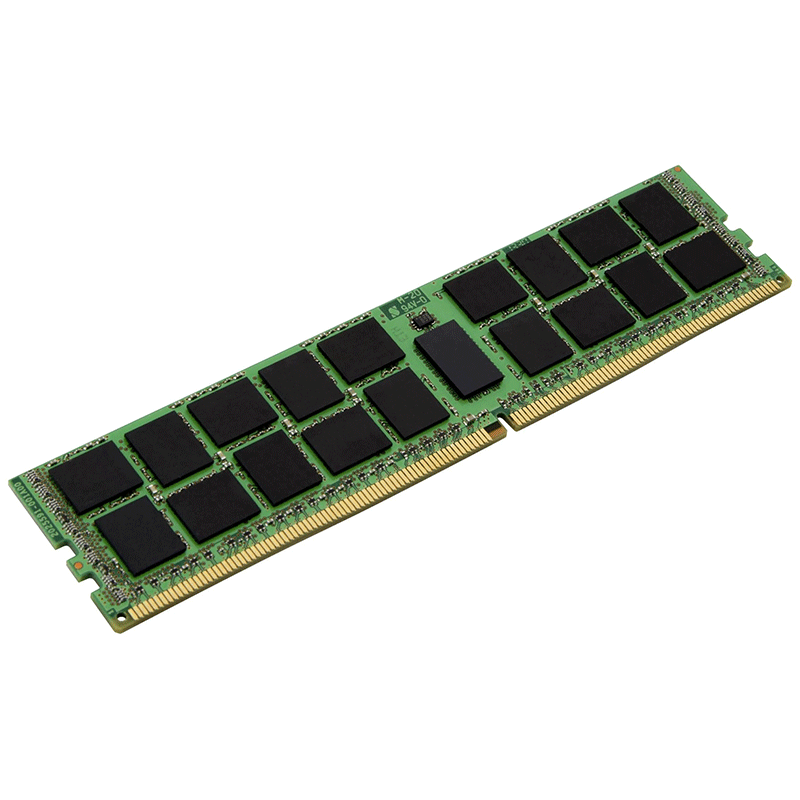
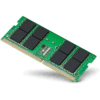
KTD-PE432D8/16G Kingston 16GB PC4-25600 DDR4-3200MHz Registered ECC CL22 288-Pin DIMM 1.2V Dual Rank Memory Module
Description Overview
- 16 GB capacity, DDR4 SDRAM.
- Speed: 3200 MHz (PC4-25600)
- Form factor: 288-pin DIMM (standard full-size desktop/server memory slot)
- ECC (Error-Correcting Code) support: yes — ensures error detection and correction, which improves data integrity and stability, especially under heavy loads/server workloads.
- Registered (buffered) — this design helps signal integrity and reliability when you have multiple DIMMs or run server-class motherboards.
- Dual-rank (2Rx8) configuration.
- Voltage: 1.20 V.
Features
- 16 GB capacity — provides plenty of memory for server or workstation workloads (e.g. virtualization, databases, heavy multitasking).
- DDR4‑3200 (PC4‑25600) — high data rate/throughput (3200 MT/s) for fast data transfer and responsiveness.
- Registered (RDIMM) + ECC (Error‑Correcting Code) — supports error detection and correction, improving data integrity and reliability, important for mission‑critical or server‑class applications.
- Dual‑rank (2Rx8) — dual‑rank configuration can improve memory bandwidth and efficiency in multi‑DIMM/server environments.
- 288‑pin DIMM form factor — standard full‑size DIMM format compatible with server/workstation motherboards that support RDIMM DDR4.
- CAS Latency: CL22 — typical latency timing for DDR4‑3200 modules; latency/throughput trade‑off tuned for reliability in server contexts.
- Low operating voltage: 1.20 V — energy‑efficient compared to older/higher‑voltage memory, reducing power consumption and heat.
- Server/workstation‑oriented design — intended for use in servers, enterprise systems, virtualization rigs or workstations that require stability, ECC, and high uptime.
Advantages
- Because it’s ECC + Registered, this module is server/workstation-grade memory and not always compatible with typical desktop motherboards that expect unbuffered (UDIMM), non-ECC or unregistered memory.
- ECC helps catch and correct certain types of memory errors — important for servers, workstations, virtualization, databases, long-uptime tasks, etc., where reliability and data integrity matter.
- Registered modules reduce electrical load on the memory controller, which helps when you populate many memory slots or run many modules — essential in servers or high-capacity workstations.
- Dual-rank modules sometimes offer a performance advantage under certain memory-controller configurations (due to bank interleaving) compared to single-rank modules.
Ideal Use Cases
- Servers & enterprise‑class machines — Because it’s a Registered ECC DIMM, it’s designed for server‑class motherboards and enterprise systems that require stability, reliability, and high memory capacity.
- Database servers / data‑critical workloads — ECC error correction helps prevent silent memory errors, which could corrupt data. For databases, transaction systems, or other workloads where data integrity is critical, ECC‑registered memory helps protect against corruption or crashes.
- Virtualization hosts / VM servers — If you run multiple virtual machines, containers, or heavy multi‑tasking servers, the stability and reliability of ECC + RDIMM help keep everything stable under load and avoid random memory faults.
- Workstations for professional workloads — For high‑end workstations doing CAD, video editing, scientific computing, rendering or other memory‑intensive / long‑uptime tasks, the module’s reliability, capacity, and speed make it a strong fit.
- Multi‑DIMM, high‑capacity builds — RDIMMs buffer memory signals, reducing load on the memory controller. This allows you to populate many DIMMs (achieve larger total RAM) more reliably than with unbuffered RAM — ideal for servers/workstations needing lots of memory.
- Always‑on systems (e.g. data centers, home servers, NAS with critical data) — The ECC ensures memory errors are corrected — reducing risk of data corruption over long uptimes.
When this is not ideal / What to check before using
-
It’s not appropriate for typical consumer desktop PCs — many consumer desktops don’t support registered ECC memory. RDIMM + ECC requires a motherboard and CPU that explicitly support registered ECC.
-
For simple tasks (web browsing, light office work, gaming), the benefits of ECC and RDIMM are rarely needed — standard desktop (non‑ECC, unbuffered) RAM is usually enough and often cheaper.
-
If you don’t need a lot of RAM or don’t plan to scale memory capacity, the premium features (ECC, registered) may be overkill relative to cost.


Reviews
There are no reviews yet.