Enterprise Servers
Mobile Workstation
Tower and Rack Workstation Series

DELL EMC PowerEdge Servers
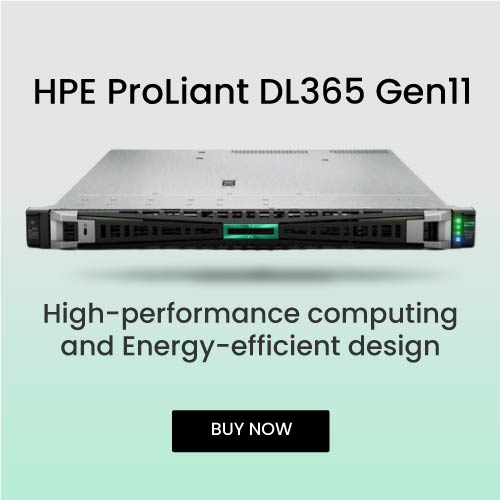
HPE ProLiant Servers

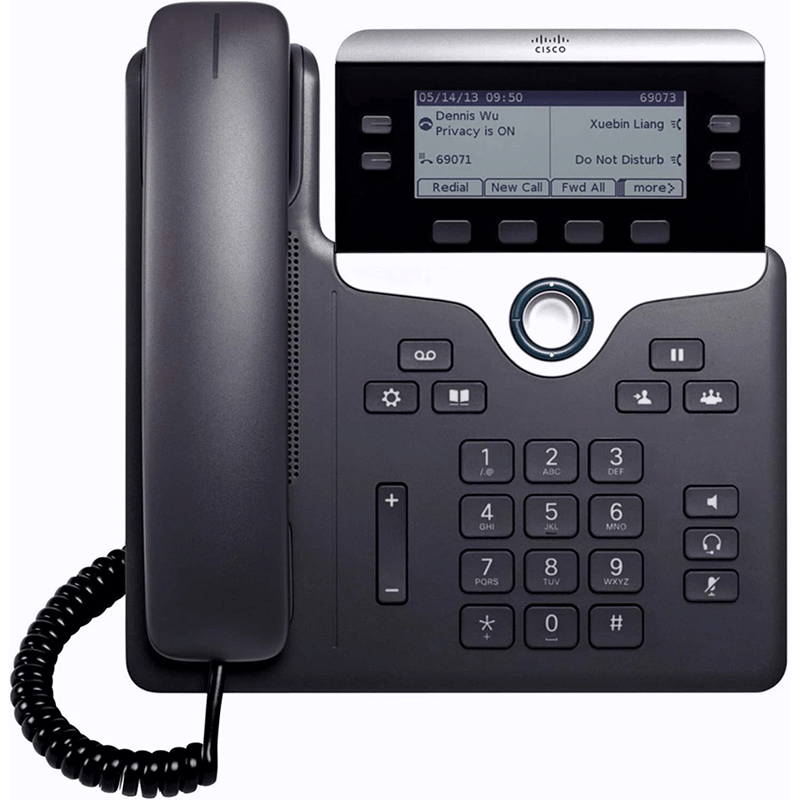
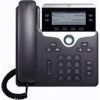
The Cisco 7861 is part of Cisco’s 7800 Series IP Phones. It’s built for users with high call volumes (e.g. contact centre agents, administrative staff, managers) and offers a lot of programmable line/feature keys.
Lines & Programmable Keys: Supports 16 programmable line buttons for multiple concurrent calls or extensions with additional fixed keys for functions such as directory, messaging, speakerphone, etc.
Display: 3.5‑inch monochrome (grayscale) backlit display, resolution: 396 × 162 pixels.
Audio Quality: Wideband audio support (e.g. codec G.722) across handset, headset, and speakerphone and Full‑duplex speakerphone.
Network & Connectivity: Dual Ethernet ports: includes an integrated switch to connect both the phone and a PC via the phone. Ethernet speed: 10/100 Mbps.
Power / Energy Efficiency: Supports Power over Ethernet (PoE) — IEEE 802.3af, Class 1 compatibility with optional AC‑to‑DC power supply when PoE is unavailable and Cisco EnergyWise support (helps with energy savings) in some deployments.
Fixed Function/Usability Features: Dedicated buttons for features like conference, directory, messaging, navigation. Replaceable bezel (frame) options (e.g. silver or black) to match decor. Two‑position footstand; also wall‑mountable.
Common Calling & Telephony Features: Supports standard telephony features: call forward, call pickup, call park, transfer, hold/resume, voicemail, mute, speed‑dial, caller ID, redial, etc. Advanced features: Busy Lamp Field (BLF), auto‑answer, headset auto‑detect, “agent greeting,” etc.
Security / Protocols: SIP signalling protocol support for secure signalling (TLS), media encryption (SRTP) in many deployments.
Environmental / Physical: Operating temperature roughly 0‑40 °C. Size and weight: ~207 × 265 × 28 mm (without stand); about 1.05 kg weight.
| 1 – Handset light strip | 2 – Phone screen | 3 – Softkey buttons | 4-Programmable feature buttons |
| 5 – Navigation and Select button | 6 – Hold/Resume button | 7- Conference button | 8 – Transfer button |
| 9 – Speakerphone button | 10 – Headset button | 11 – Mute button | 12 – Keypad |
| 13 – Volume button | 14 – Contacts button | 15 – Applications button | 16 – Messages button |
| 17- Handset | |||
Reviews
There are no reviews yet.