Enterprise Servers
Mobile Workstation
Tower and Rack Workstation Series

DELL EMC PowerEdge Servers

HPE ProLiant Servers

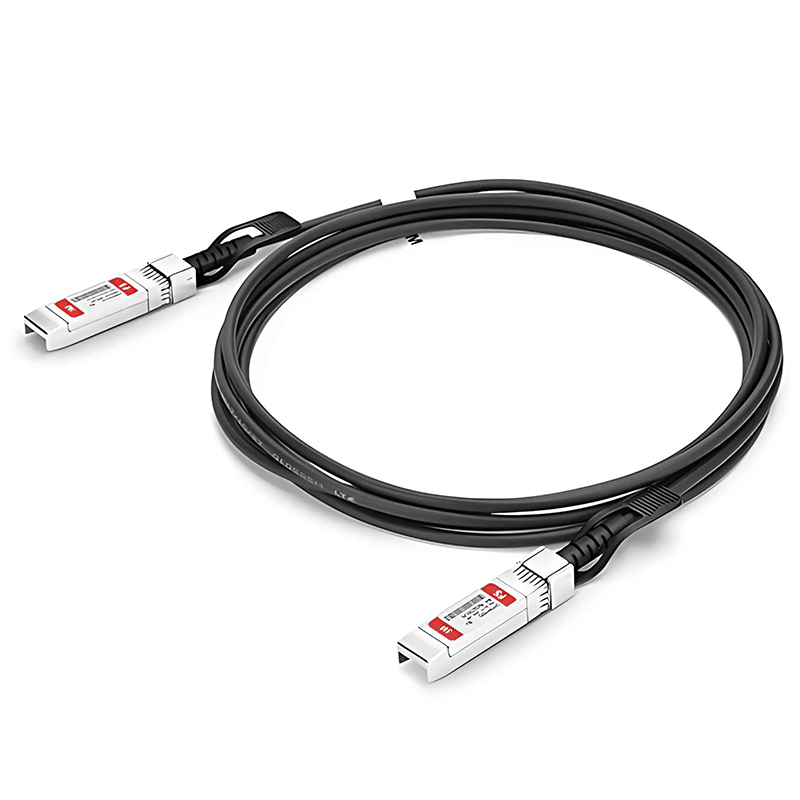
3m (10ft) HW SFP-10G-CU3M Compatible 10G SFP+ Passive Direct Attach Copper Twinax Cable — High-performance, cost-effective 10Gbps SFP+ to SFP+ DAC cable designed for short-range connections up to 3 meters. Fully compatible with HW SFP-10G-CU3M modules, ideal for data centers, server rooms, and high-speed network environments.
The 10G SFP+ Passive Direct Attach Copper Twinax Cable offers a cost-effective connectivity for establishing a 10-Gigabit short-distance connectivity within a rack or between adjacent racks in data centres. The Passive Direct Attach Cable is an ideal 10GBASE Ethernet network solution that require reliability, low latency, and practically no power consumption. DAC cables are lower cost, more durable than optical fibres. This cable provides low insertion loss and ultra-low crosstalk. And it complies with IEEE 802.3, SFF-8431, and hot-pluggable QSFP28 MSA standards, ensuring reliability of your network with full system testing in targeted Switches. Note: FS Box does not currently support changing H3C and HPE compatibility for DAC cables.

Lower Cost: Because you don’t need optical transceivers + separate fiber patch cables, the overall component cost is much lower. The cable itself is cheaper than the combo of transceiver + fiber, especially for short runs.
Low Power Consumption: Passive DACs consume very little power (often < ~0.1 W). No need for laser drivers, optical receivers, etc. That’s good for large installations where hundreds of links accumulate power usage.
Lower Latency: Since you avoid the optical conversion (electrical‑to‑optical, optical‑to‑electrical) involved in optical transceivers, latency tends to be less. Every conversion adds small delay; skipping them gives faster signal transit. (Important in e.g. HPC, financial etc.) Implicit in documentation comparing optics vs DACs.
High Reliability & Simplicity: Fewer parts means fewer failure points. Copper connectors/cable assemblies have less to go wrong vs. optics (which may have lasers, receivers, etc.). Also simpler to replace.
Compliant & Standardized (MSA etc.): These cables usually comply with SFP+ MSA, IEEE standards for 10GBASE‑CU etc. So interoperability is good if hardware supports it.
Good for Short‑Reach, Dense Environments: Perfect for connecting switches to servers in the same rack, or between adjacent racks over short distances (3m is a typical “short‑reach”). Offers good density, clean cable runs.
Hot‑pluggable: These cables can be plugged/unplugged while systems are on (if equipment supports hot swapping). That aids maintenance without downtime.
Lower EMI / Electromagnetic Interference Issues (comparatively): Twinax cables are shielded, often with very short differential paths, so may be more robust in terms of interference than longer copper runs or fiber connections with optical‑electrical parts. (Although fiber is immune to electrical noise, but the “edges” still matter.) The cable impedance, shielding, etc. are well specified (e.g. 100 Ω) for good signal integrity.




Reviews
There are no reviews yet.